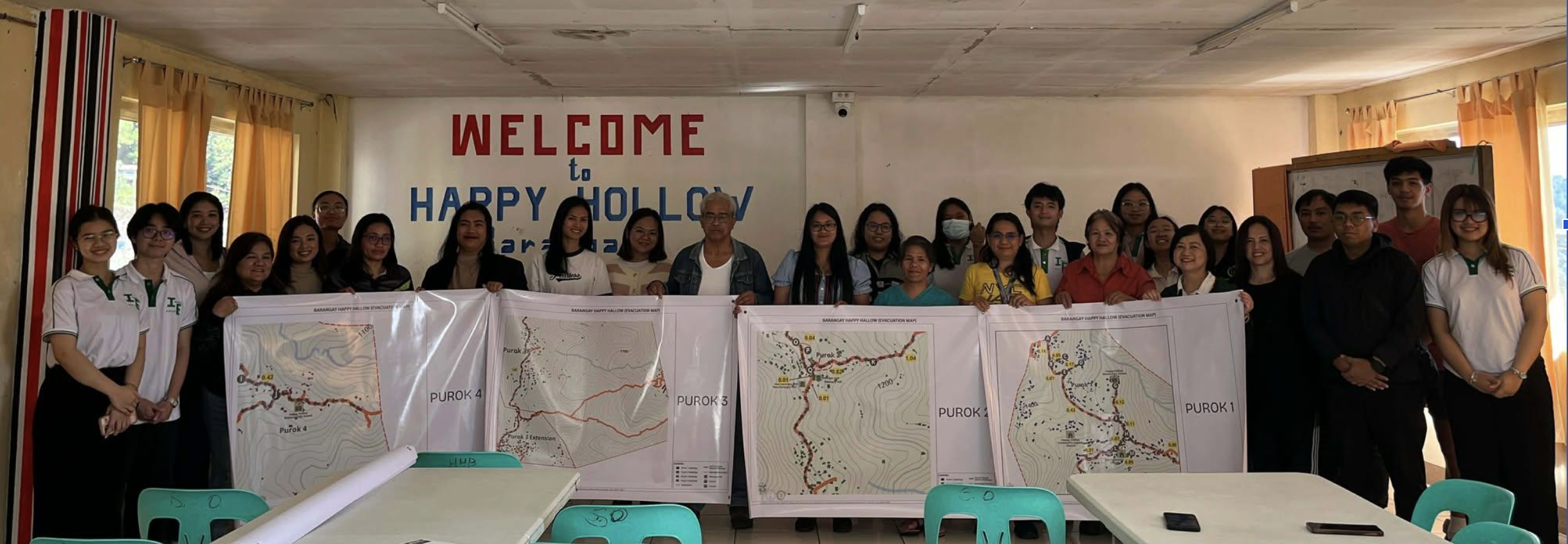
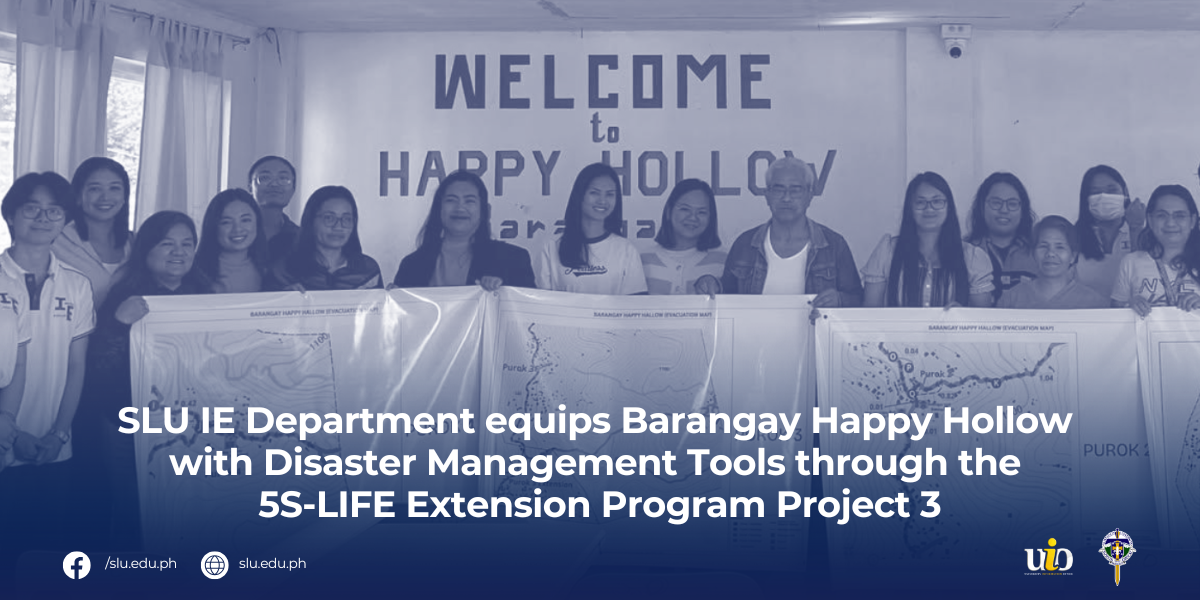
The Saint Louis University (SLU) Industrial Engineering (IE) Department of the School of Engineering and Architecture (SEA) successfully turned over to Happy Hollow Barangay, the Barangay Disaster Risk Reduction and Management (BDRRM) Dashboard Barangay Disaster Analytics System (BDAS), as well as the Barangay Spot Map and Evacuation Maps (BMAPS), to enhance the barangay’s disaster, risk reduction, and management program. The turnover of the BMAPS was done on 17 February 2026, while the turnover of the BDAS was held on 29 May 2026. Both projects were the IE Department’s output for Project 3 of their 5S-LIFE extension program.
The extension program in AY 2025-2026 focused on equipping barangay officials with a digital information system to address the need for a more structured and responsive disaster risk management system. By introducing an information system built on SQL and Excel, the BDAS dashboard allows the barangay officials to monitor, manage, and communicate disaster-related information more efficiently.
Furthermore, instead of relying on intuition or experience-based practices to identify evacuation routes, the BMAPS used QGIS, while the BEVAC (Barangay Evacuation Routes and Facilities) used network analysis to identify optimal pathways from various purok locations to the nearest evacuation centers during disasters.
The SLU IE Department has been actively involved in Barangay Happy Hollow prior to Project 3 through a number of extension initiatives based on the 5S approach, an organized workplace organization system designed to increase productivity, efficiency, and safety. Project 3’s BMAPS and BDAS are part of the “Standardize” phase of the comprehensive 5S-LIFE program, which introduces digital tools and information systems to enhance the barangay’s disaster, risk reduction, and management program.
The extension program team consists of the faculty of the Industrial Engineering Department, namely Engr. Geraldine G. Nerona (Program Coordinator), Engr. Michelle C. Adiwang, Engr. Maria Lourdes Bibit-Chee, Engr. Cristy S. Blante, Engr. Anthony James G. Domingo, Engr. Cheslyn Linghai Espada. Engr. Maria Corazon D. Ocampo, Engr. Mark Emriel S. Parlan, Engr. Patrick Franz Pascua, Engr. Sydney Jade Ortiz, Engr. Rhea Krizelle Solomon, and Engr. Abegail S. Tagal. The team included the SLU-IE students: Jaztice Junelle Cariaga, Raya Colcol, Claire Ashley De Quintos, Jireh Jose Irangan, Kaiserie Zhea Alliah Kuizon, Zyrelle Kyle Martinez, Krista Mae Ramos, Leonardo Fabian Sales, and other 3rd Year IE students, who were led by Mac Steeven Cabrera, PIIE SLU SC Vice President for External Affairs.
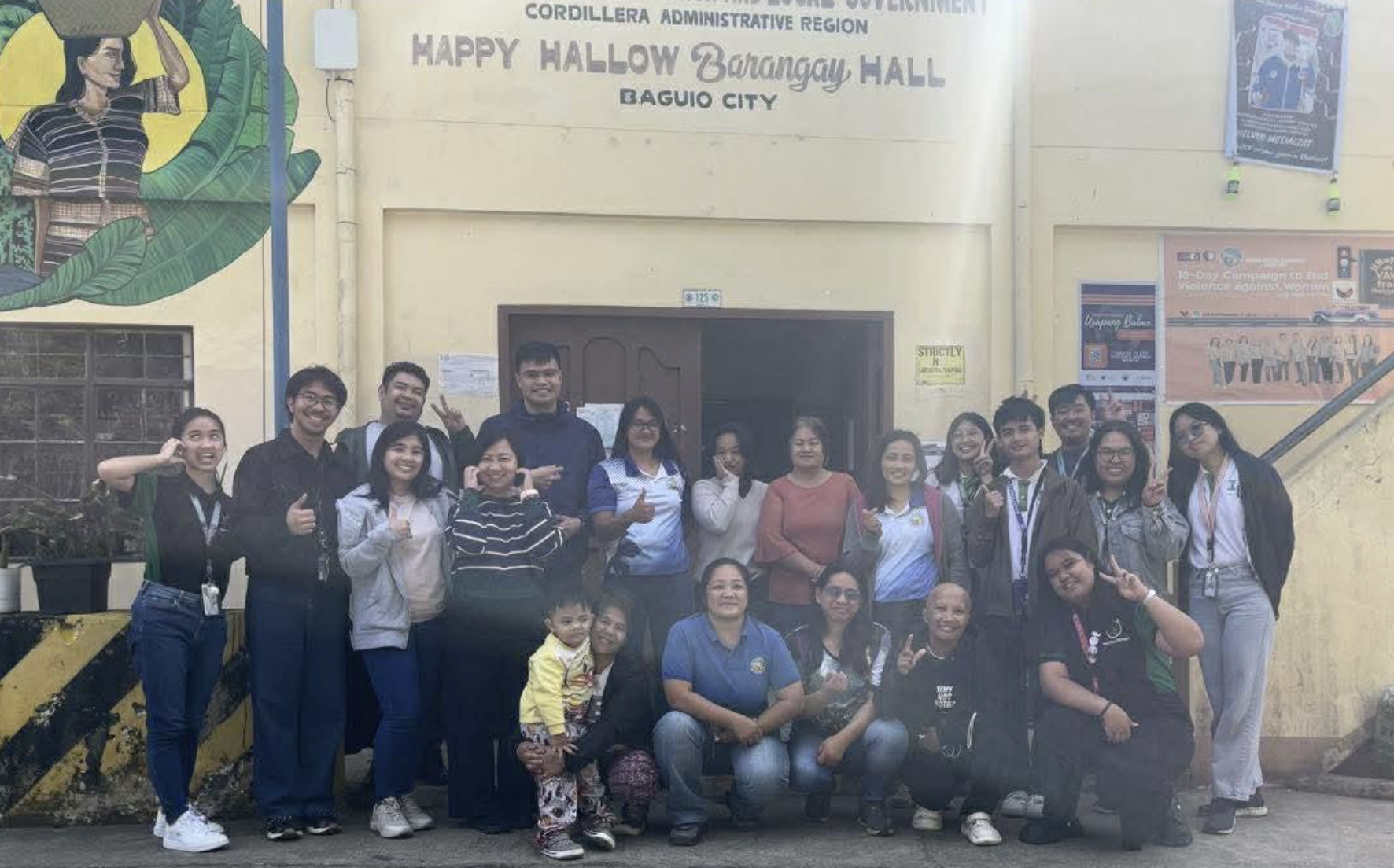
To ensure the sustainability of use of the BMAPS and BDAS, the extension team crafted a User Manual for both systems to serve as a reference for the users after the project’s turnover. Additionally, the extension team conducted a one-on-one training session with barangay officials on 07 and 19 March 2026. The training was hands-on, with the team walking each official through the system, showing them how to operate the BDAS, update the BMAPS, and create disaster preparedness reports. The one-on-one approach ensured that each official felt comfortable using the system independently.
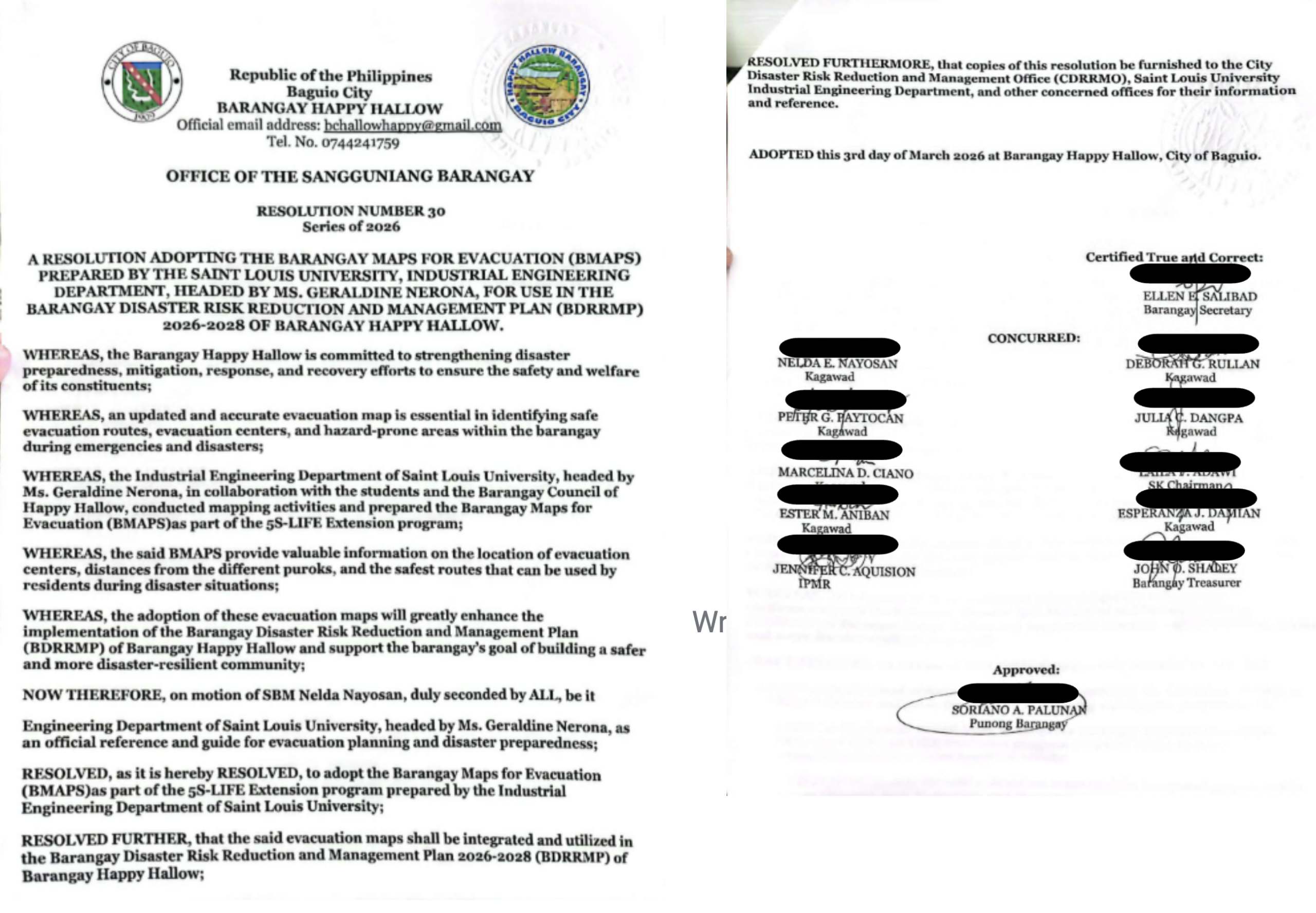
The impact of these systems introduced through the extension program was evident in the Barangay Resolutions crafted and approved by the Happy Hollow Barangay Council, which ensured the adoption of the BMAPS and BDAS as their official systems in line with their BDRRM.
Barangay Resolution Number 30 S. 2026 for Adoption of BMAPS
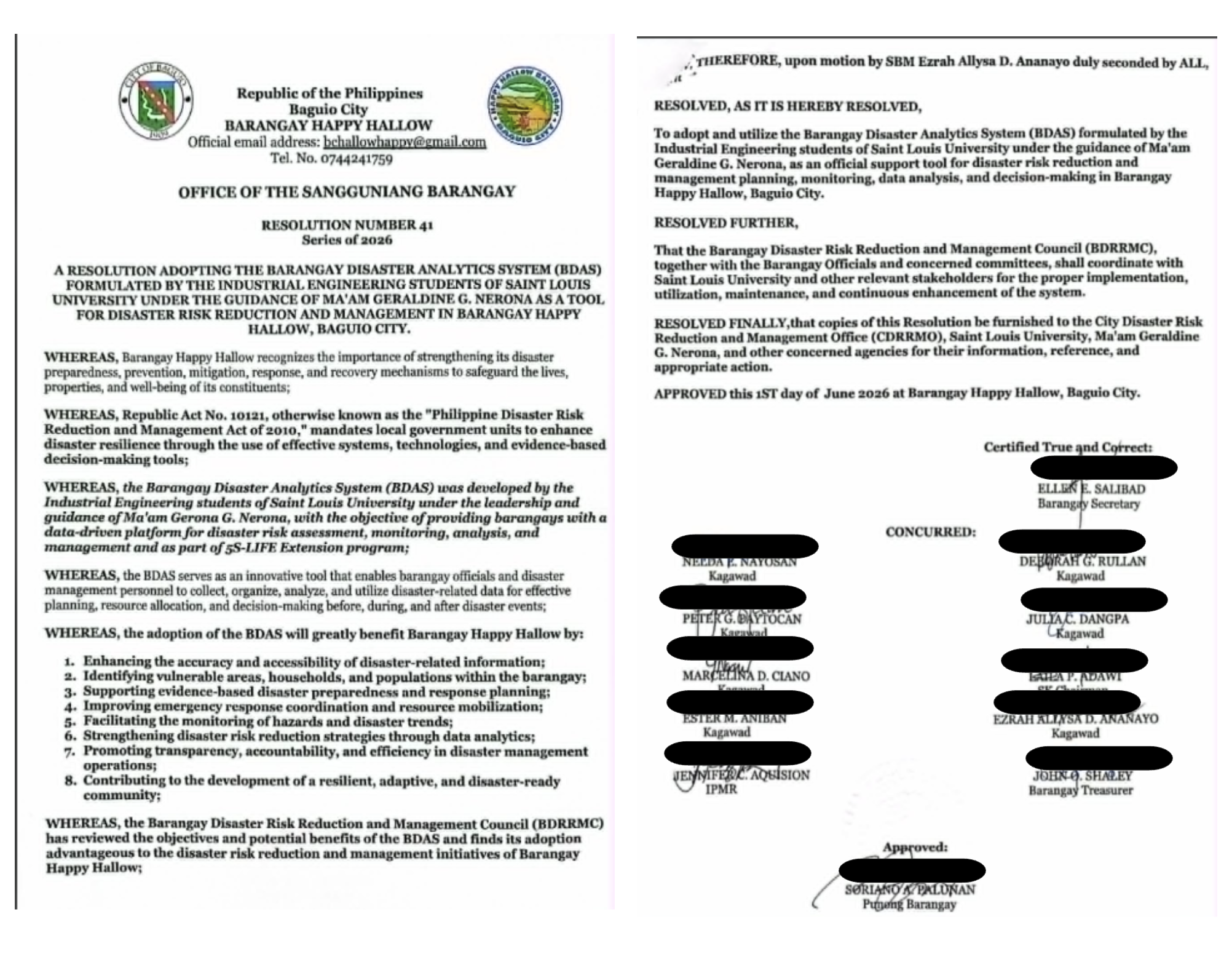
Barangay Resolution Number 41 S. 2026 for Adoption of BDAS
Scholarly Contribution of the Extension Program
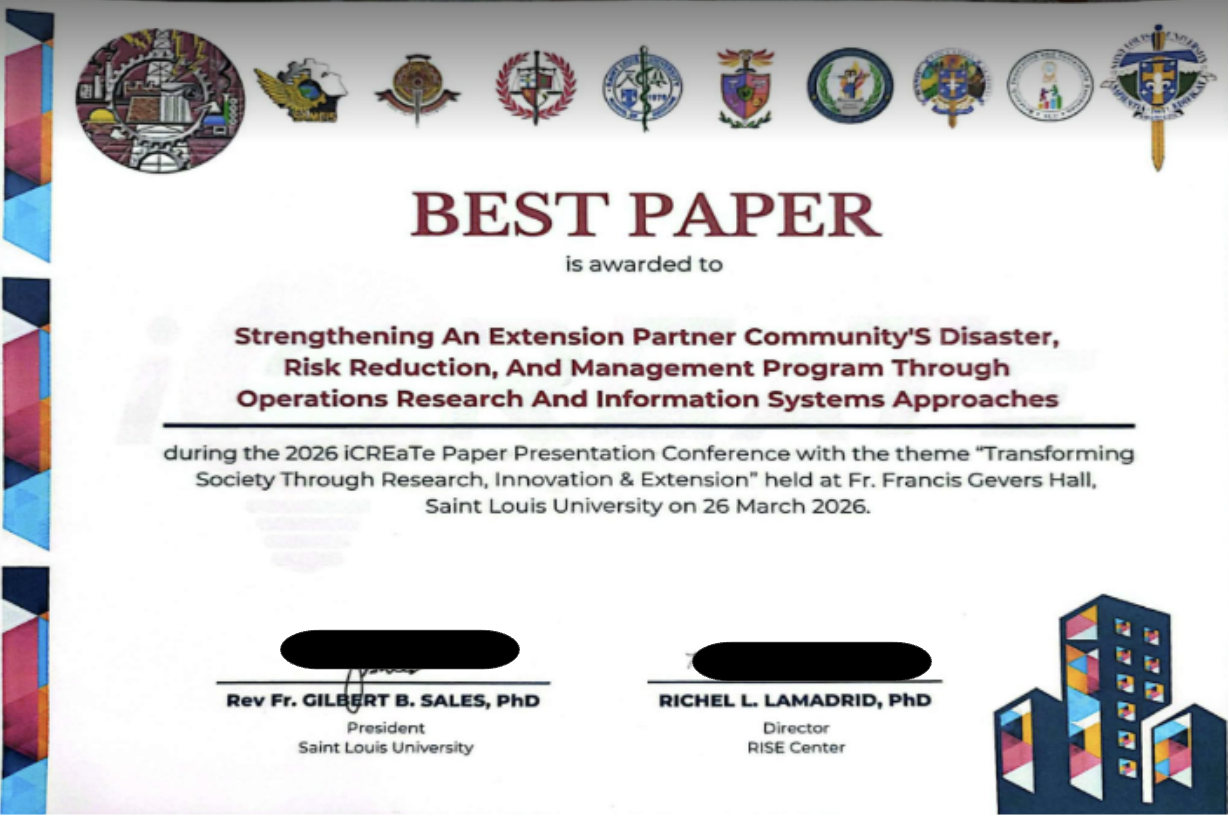
An extension research was undertaken by the extension core team, headed by Engr. Geraldine Nerona, through a capstone project during the second semester of AY 2025-2026. The student research team comprised Krista Mae Ramos, Zyrelle Kyle Martinez, Jaztice Junelle Cariaga, Ashlee Jade Rozul, Raya Colcol, Faona Lyn Gawidan, Zyrylle Gupaal, Callen Rey Maliacos, Froilan James Dalasen Jr., and Elijah James Balawag. The extension research was written to properly measure the impact of the Project 3 activities, which covered the BEVAC (Barangay Evacuation Routes and Facilities), BMAPS, and BDAS on the Happy Hollow Barangay’s BDRRM program. The extension research won the Best Paper award at iCreate 2026, held at SLU Gever’s Hall on 25 March 2026.
Journal Publication Effort
As part of the extension team’s commitment to community service while upholding academic excellence, the extension research team submitted the same research to the Journal of Intelligent Systems and Advanced Data Science (JISADS), an international, peer-reviewed journal, on 28 May 2026. Initial acceptance was granted by the editor-in-chief on 02 June 2026, and the article is currently under peer review.
The extension program aligns with achieving UN Sustainable Goals 4 (Quality Education for all), 9 (Industry, Innovation, and Infrastructure), 13 (Climate Action), 16 (Justice, Peace, and Strong Institutions), and 17 (Partnership with the Goals). (Article by Kailynne M. Villarin and Geraldine G. Nerona, IE Department | Photos by IE Department)